
Why the Double-Slit Experiment Is Not a Mystery
For a hundred years, physicists have said this experiment is “impossible to understand.” Medium Theory SMT disagrees — and offers a physical mechanism, not an interpretation.
The Experiment That Broke Physics
The double-slit experiment has a peculiar status in the history of science. It is not exotic — no extreme temperatures, no particle accelerators, no cosmological distances. A source, two narrow slits, a detector screen. And yet Richard Feynman called it “the only mystery of quantum mechanics,” a phenomenon that “cannot, cannot, cannot be explained in any classical way.”
When individual electrons — one at a time — are fired at a screen with two slits, they build up an interference pattern. The kind of pattern that only waves make. But each electron lands as a point. A particle. The pattern only emerges after many such arrivals, each seemingly random, yet collectively forming an unmistakable structure of constructive and destructive interference.
The accepted response to this over the past century has been interpretational rather than physical. Copenhagen: the electron exists as a wave of probability until measured, at which point it “collapses.” Many-worlds: every measurement branches reality. De Broglie–Bohm: a “pilot wave” guides the particle, but the wave itself is abstract. What none of these provide is a mechanism — a physical account of what is actually happening in the experiment.
Medium Theory SMT proposes that the mystery disappears once the underlying ontology is corrected: space is not an empty stage on which particles move. It is a continuous physical medium Φ, and what we call “particles” are localized topological configurations of that medium.
Two Objects, Not One
The central conceptual move in SMT’s treatment of the double-slit experiment is a clean separation that standard quantum mechanics conflates into a single object — the wave function ψ.
In SMT, an electron is two physically distinct things:
The knot — a topologically stable, localized configuration of the medium Φ, with a characteristic size on the order of the Compton wavelength, approximately 4 × 10⁻¹³ m. This is what registers on the detector screen. It is local, it travels through one slit, and it carries energy concentrated in a small region.
The medium perturbation δΦ — an extended wave excited by the moving knot, propagating through the medium much as a boat generates a wake. This perturbation is not abstract. It satisfies a physical wave equation:
The perturbation is non-local — it extends across the entire accessible region of the medium, including both slits simultaneously. The knot is local — it passes through exactly one slit.
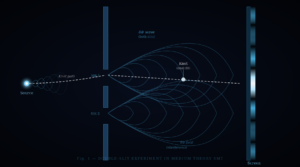 Fig. 1 — The knot (localized topological configuration) passes through one slit. The medium perturbation δΦ propagates through both. The interference pattern on the screen is formed by δΦ, not by the knot itself.
Interference Without Paradox
Once the knot and the δΦ field are distinguished, the interference pattern requires no interpretational gymnastics. Behind the barrier, the two branches of δΦ — one from each slit — superpose. The resulting intensity pattern is:
This is not the interference of a probability amplitude. It is the physical interference of a real field perturbation in the medium Φ. The mathematics is identical to standard quantum mechanics — but the ontology is different. The interference fringes are the structure of the medium itself, not a statistical bookkeeping device.
The knot, moving through this structured medium, experiences an effective potential created by |δΦ|². Specifically, it is attracted toward regions of constructive interference — where medium energy density is high:
Each individual knot follows a deterministic trajectory, governed by its initial position, momentum, and the phase φ₀ of the surrounding δΦ field. The statistical distribution across many trials — the interference pattern — emerges from the fact that φ₀ cannot be controlled with arbitrary precision. It depends on the microscopic state of the medium, which varies from shot to shot. Probability arises from incomplete knowledge of initial conditions, not from fundamental indeterminism.
Measurement as Physical Relaxation
In standard quantum mechanics, “measurement” — the collapse of the wave function — has no physical description. It is an axiom imposed from outside the formalism. In SMT, it is a physical process with a timescale.
A detector is a large deformation of medium Φ with many internal degrees of freedom. When the knot interacts with the detector, a sequence of physical processes occurs: energy transfer, coherence destruction, phase randomization, and irreversible relaxation. The coherence of δΦ is destroyed — not because an “observer” intervened, but because the detector physically disrupted the medium state.
The characteristic collapse timescale is:
For a macroscopic detector with ΔE ~ eV, this gives τ ~ 10⁻¹⁵ s. Collapse is fast, but it is a physical process with a beginning, a middle, and an end — not an instantaneous projection.
Destroying the Pattern by Observation
The “which-way” experiments — where a detector is placed near one slit to determine which path the particle took — consistently destroy the interference pattern. In Copenhagen quantum mechanics, this is attributed to the act of gaining information about the particle’s path. The particle “knows” it is being watched.
In SMT, the explanation is mechanical. A detector near slit 1 introduces a large gradient ∇Φdetinto the medium. This scatters the δΦ field and destroys its phase coherence before the two branches can interfere behind the screen. The interference is lost not because information was acquired, but because the medium was physically disrupted.
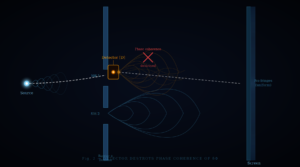 Fig. 2 — A detector near slit 1 introduces a large gradient ∇Φdet, scattering the δΦ field and destroying phase coherence before the two branches can interfere. The interference pattern vanishes — not because a measurement occurred, but because the medium was physically disrupted.
Comparison with Other Interpretations
| Interpretation | What interferes | Nature of collapse | Locality |
|---|---|---|---|
| Copenhagen | Wave function ψ | Postulate | Unclear |
| Many-Worlds | Branching worlds ψ | Absent | Preserved (?) |
| de Broglie–Bohm | Pilot wave ψ | Absent | Non-local |
| SMT | Physical field δΦ | Medium relaxation | Preserved |
The key distinction is ontological. Copenhagen, Many-Worlds, and de Broglie–Bohm all treat the wave function as the fundamental object — whether as a probability amplitude, a branching history, or a guiding field. SMT replaces the abstract ψ with a physical perturbation of a real medium. The formalism is compatible with quantum mechanics in all predictions; the physical content is categorically different.
What the Double-Slit Experiment Actually Tells Us
The conclusion of this analysis is not modest. The double-slit experiment, in the SMT framework, is not an anomaly requiring special interpretational treatment. It is a direct observation of the physical structure of the medium Φ.
The interference pattern is the spatial structure of the medium itself — the superposition of δΦ waves propagating through a physical substrate. The probabilistic distribution of particle arrivals is classical statistics applied to initial conditions that cannot be controlled at the microscopic level. The disappearance of interference upon measurement is the physical disruption of medium coherence by a macroscopic detector.
Realism, determinism, and locality — three properties that Copenhagen quantum mechanics explicitly abandoned — are restored. Not through some speculative modification of quantum mechanics, but through a reinterpretation of what the wave function represents physically.
The experiment that “broke physics” turns out to be the clearest window into the structure of spacetime as a nonlinear elastic medium.